You have seen the ways to focus in a world of distractions. What if it fails even then?
You concentrated on tasks that warranted your close attention but you still failed. Now its time to learn the most important process of all. The art of REFOCUS after you lost the track.
When Focus Fails: Why the Real Power Lies in Coming Back
You don’t need to stay focused forever. You just need to know how to return.
The Lie of Perfect Focus

Let’s be honest — focus has become one of the most overhyped and misunderstood words of our time.
We’re told to “lock in,” “stay sharp,” and “grind harder.”
We download apps, listen to lo-fi playlists, block websites, and discipline ourselves like machines.
But here’s the truth: no one stays focused all the time.
Not the most productive CEO, not the most mindful monk, not even the most creative artist.
Every mind wanders. Every flow fades. Every attention span fractures.
And yet — the moment we lose focus, we call it failure.
That’s the real problem.
Not distraction itself — but the shame we attach to it.
You don’t break when you get distracted.
You break when you start believing that being distracted means you’re broken.
The Hidden Cost of Losing Focus
Every time you promise yourself you’ll focus — and then you don’t — a tiny crack appears in your self-trust.
You start feeling unreliable to your own word.
You begin confusing temporary distraction with personal weakness.
That quiet guilt that whispers “You’re not disciplined enough”?
That’s the true mental exhaustion — not the work itself.
Over time, this guilt becomes a loop:
-
You lose focus.
-
You feel guilty.
-
You overpromise to do better.
-
You fail again.
And somewhere between all this effort, you stop enjoying the process.
You no longer create for joy — you perform for validation.
You no longer rest — you recover from burnout that shouldn’t exist.
You don’t need another focus app or productivity hack.
You need a reset button for the mind.
Refocus: The Skill We Were Never Taught
Here’s something no one told you growing up:
Focus is not the goal. Refocus is.
Focus is a state — temporary, delicate, easily disturbed.
Refocus is a skill — trained, resilient, and repeatable.
When you learn how to come back after distraction, you become unstoppable.
Because the world will always pull your attention — notifications, noise, deadlines, emotions — but if you can reset without judgment, you never truly lose your direction.
That’s what mental resilience really is.
Not resistance — recovery.
The Science of Return
Every time you catch yourself drifting and gently come back, your brain rewires itself.
This is called neuroplasticity — your mind’s ability to reshape through repetition.
When you focus, lose attention, and then refocus, you’re teaching your neurons to build a stronger bridge back to awareness.
That’s how “attention endurance” grows.
So the goal isn’t to stop drifting — it’s to shorten your comeback time.
That small interval between noticing distraction and returning to task — that’s where your power lives.
It’s not the length of your focus that defines success.
It’s the speed of your return.
Why Willpower Doesn’t Work
Most of us try to fix distraction through force —
locking phones away, timing every minute, punishing ourselves for breaks.
But your brain doesn’t respond well to punishment.
When you feel shame or frustration for losing focus, your stress hormone (cortisol) spikes, and your attention center (the prefrontal cortex) actually shuts down.
You’re not helping yourself focus — you’re creating internal resistance.
It’s like trying to calm waves by shouting at the ocean.
What works instead?
Kind awareness.
Notice, breathe, reset, and re-enter.
Compassion, not control, creates clarity.
The 4R Framework: A Simpler Way to Come Back
In my book, Refocus: The Lost Art of Coming Back, I describe what I call the 4R Framework — a simple, neuroscience-backed process to recover clarity in any moment.
You can practice it right now:
-
Recognize – Notice you’ve drifted. Say internally, “I’m distracted.”
-
Release – Take a deep exhale. Drop the tension.
-
Reframe – Ask, “What pulled me away — fatigue, boredom, emotion?”
-
Refocus – Take one small, meaningful action to return.
It takes less than 90 seconds, yet it resets your entire mental circuitry.
It’s mindfulness without mysticism — awareness in motion.
Repeat this cycle daily, and it becomes instinct.
Soon you won’t fear distraction — you’ll just navigate it.
The Myth of Endless Motivation
Here’s a sobering fact:
Motivation is a chemical, not a character trait.
It comes in bursts of dopamine — short-lived, volatile, unpredictable.
That’s why it’s so easy to start new things and so hard to sustain them.
You don’t need to “stay motivated.”
You need to stay available — ready to begin again, no matter how many times you fall off.
That’s what refocus trains — availability, not hype.
You show up for the next moment, not the perfect one.
That’s how masterpieces, habits, and calm minds are built: one gentle return at a time.
Designing Your Reset Routine
The biggest lie in self-development is that consistency means doing the same thing every day.
Real consistency means returning every day — even if yesterday was chaos.
A Reset Routine isn’t strict — it’s rhythmic.
Here’s a simple structure to start:
Morning:
Spend 5 minutes in silence before touching your phone.
Ask, “What deserves my focus today?”
Not what’s urgent — what’s meaningful.
Midday:
Take a 2-minute break after every 90 minutes of work.
Don’t scroll. Just breathe, stretch, look outside.
Night:
Before bed, reflect: “Where did I lose myself today — and how did I return?”
Write one line of gratitude for your awareness.
These resets seem small, but they save hours of scattered energy.
Because rest isn’t unproductive — it’s maintenance for focus.
When Life Interrupts
Even with perfect habits, life will crash through your plans.
Someone will need you. Something will fail. A mood will collapse you.
And that’s okay.
You’re not built to maintain perfect focus in a chaotic world — you’re built to recover from it.
Refocus is the art of emotional agility — bending without breaking.
You no longer spiral when interrupted; you adapt and return.
You stop reacting, start responding.
You stop overcontrolling, start understanding.
And that shift changes everything — from your work to your relationships to your self-talk.
Flow is Not Magic — It’s Memory
You know those moments when you’re “in the zone”?
Hours pass like minutes. Ideas flow effortlessly. You forget yourself.
That’s flow, and it’s not mystical — it’s mechanical.
It’s what happens when your challenge meets your capacity in perfect rhythm.
But here’s the part few people know:
Flow is repeatable.
You can re-enter it if you know your anchors — the sounds, environment, posture, and emotion that trigger it.
That’s why refocus isn’t just about fixing distraction — it’s about finding flow faster.
You learn your personal cues for immersion.
You design your space to support silence.
You build your life around cycles, not chaos.
Flow, then, stops being a lucky accident and becomes a daily design.
Why Refocus is More Than Productivity
This isn’t just about attention — it’s about peace.
When you stop fighting distraction, you stop fighting yourself.
You stop seeing focus as a battle and start seeing it as a dialogue — between your mind, body, and attention.
The refocused life isn’t about doing more.
It’s about being more present while doing.
And that presence changes everything:
-
Work becomes deeper.
-
Rest becomes richer.
-
Relationships become clearer.
-
Life becomes quieter — even in noise.
Because you’re no longer chasing moments.
You’re living inside them.
Also read the latest: You are what you think
The 30-Day Return
You can retrain your mind in 30 days — not to never drift, but to always come back faster.
Here’s a starter blueprint:
-
Week 1: Notice every drift — awareness only, no guilt.
-
Week 2: Practice one 4R reset daily.
-
Week 3: Add an emotional reset before bed (breathe, release, reflect).
-
Week 4: Protect one flow hour daily — your “zone” time.
By the end, refocus becomes instinct.
Your comeback time shrinks.
Your energy rises.
And you’ll realize you were never unfocused — just untrained in returning.
The New Definition of Strength
Strength isn’t in perfect consistency.
It’s in graceful recovery.
Anyone can focus when life is calm.
The real masters are those who can reset when life isn’t.
Because focus is a flame.
Refocus is the hand that protects it.
When you master that, you stop being afraid of chaos —
you just learn how to come back home.
Can Astral Projection be used for improving life?
Closing Thought
You don’t need to restart your life every Monday.
You don’t need to feel guilty every time your attention slips.
You don’t need to be perfect — you need to be present enough to begin again.
That’s what refocus really means.
It’s not self-control — it’s self-connection.
When you practice it, every moment becomes a new beginning.
And maybe that’s all we’ve ever needed — not more focus, but a way to find ourselves again and again.
If this resonates with you…
If this message feels like a mirror —
if you’ve ever whispered “I can’t focus anymore” —
then you’ll find your calm, your clarity, and your comeback inside my new book:
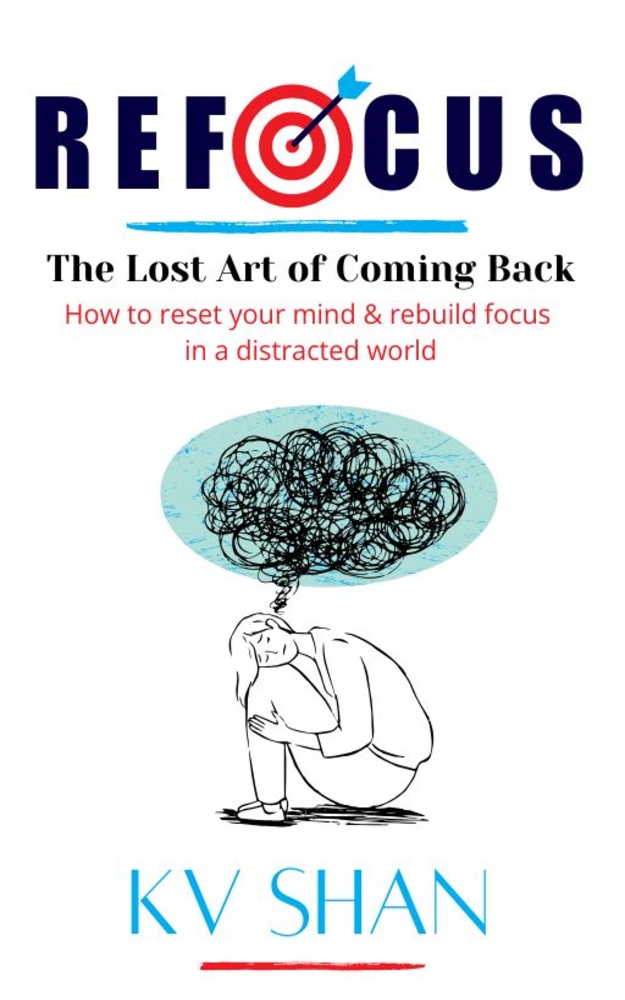
➡ REFOCUS: The Lost Art of Coming Back
A practical, soulful guide to reclaim your mind, one return at a time.
Includes daily reset practices, neuroscience-based frameworks, and the 30-Day Refocus Challenge.
US
https://www.amazon.com/dp/B0FYDCQ3XC
UK
https://www.amazon.co.uk/dp/B0FYDCQ3XC
IN
https://www.amazon.in/dp/B0FYDCQ3XC?dplnkId=c1c9af1c-1a44-4aee-85bb-7a6f67dd6516
You don’t need a perfect plan. You just need to know how to return
Also read the latest: You are what you think
Visit: https://miscverse.blogspot.com/2025/12/the-new-rich-new.html