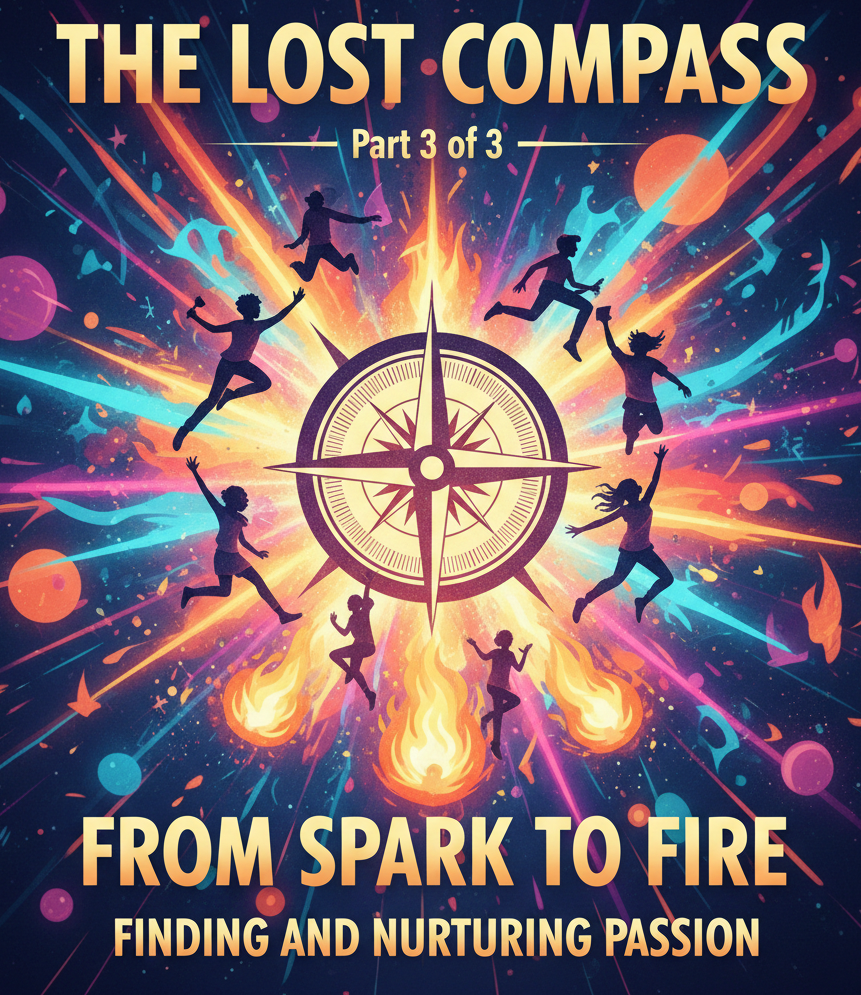
Part 3 of 3: From Spark to Fire —
Finding and Nurturing Passion
“Passion isn’t found in a day; it’s grown through days that matter.”
Every generation has a defining struggle.
For today’s youth, it isn’t scarcity of resources — it’s scarcity of direction.
We live in a world of infinite possibilities, yet so many feel numb, unsure, or indifferent when
asked:
“What are you passionate about?”
The truth is, passion isn’t a sudden epiphany.
It’s a process of discovery — built slowly, through curiosity, courage, and consistency.
1. The Myth of “One Big Passion”
We’ve been told that everyone has a single passion waiting to be “found.”
Like a hidden treasure buried somewhere in the soul.
That’s not true.
Most people create their passion through engagement, not accident.
Research by psychologist Angela Duckworth (known for her work on grit) shows that passion
is rarely a lightning bolt moment. It evolves when you spend enough time doing something
you find meaningful — even imperfectly.
Passion is not born; it’s built.
2. The Problem with Instant Clarity
Social media highlights success stories, not journeys.
We see 18-year-old prodigies, 22-year-old entrepreneurs, and 25-year-old millionaires.
It creates a false timeline — a pressure to “figure it all out” early.
But passion doesn’t follow a deadline. It follows attention.
You can’t think your way into passion — you must do your way into it.
Start small, stay consistent, and let the excitement evolve. The spark may come from a
random experiment that grows into lifelong work.
3. Curiosity: The First Seed of Passion
Before passion comes curiosity — that faint tug of interest in something that feels oddly
satisfying.
It could be:
Writing random thoughts in a notebook
Editing short videos
Asking deep questions
Observing human behavior
Taking things apart to see how they work
Most people ignore this soft whisper of curiosity because it doesn’t look “productive” yet.
But that’s exactly how passion hides — in the things you enjoy when no one’s grading or
paying you.
Curiosity is your compass. Follow it — even when it leads you off the usual path.
4. Exposure Creates Passion
A major reason young people struggle to find passion is limited exposure.
You can’t love what you’ve never met.
If your environment only shows you five career paths, how can you imagine the other fifty?
That’s why exploration — internships, volunteering, workshops, hobbies — is essential.
Exposure transforms the abstract (“I like music”) into the specific (“I love composing
soundtracks for short films”).
That specificity gives passion shape and direction.
5. The 3E Formula: Explore → Experiment → Evolve
To nurture passion, follow this cycle:
Explore
Try different experiences. Attend workshops. Talk to people from varied fields.
Don’t aim for perfection — aim for discovery.
Experiment
Give your curiosity a form. Start projects, join clubs, take short online courses.
You’ll fail sometimes, but each attempt refines your interest.
Evolve
After enough exposure and experimentation, patterns appear.
You’ll start to notice what keeps you coming back even after setbacks.
That’s your evolving passion.
6. The Emotional Side of Passion
Passion isn’t just excitement — it’s emotional endurance.
The willingness to persist through frustration because the work itself matters.
The difference between a hobby and a passion lies in depth:
A hobby makes you happy when things go well.
A passion gives you meaning even when things don’t.
So don’t chase the high of interest; chase the pull of significance.
7. The Intersection of Passion, Strength, and Purpose
To truly thrive, passion must align with two other dimensions:
Element Question Outcome
Strengths What am I naturally good at? Confidence
Passion What do I love doing? Energy
Purpose How does it help others or add meaning? Fulfillment
When all three overlap, you find your sweet spot — your “Ikigai,” as the Japanese call it: the
reason for being.
Passion alone may burn out. But passion guided by strength and purpose sustains for life.
8. Case Study: Rohan — The Reluctant Coder
Rohan joined computer science reluctantly because his parents insisted.
He hated theory, failed his first coding test, and felt he wasn’t cut out for it.
One day, he started designing a simple app to help his visually impaired classmate navigate
campus.
For the first time, coding felt alive.
He stayed up nights fixing bugs, not because of grades — but because it mattered.
Today, Rohan works in assistive tech.
His passion wasn’t coding — it was creating things that help others.
Coding was just the medium.
That’s how passion often works: it hides behind purpose.
9. How to Find Your Spark — Practical Guide for Youth
Step 1: Follow What Fascinates You
List 5 things that make you curious — topics, problems, or people you naturally think about.
Curiosity is the raw material of passion.
Step 2: Test Your Interest
Do something tangible — watch tutorials, take a small project, volunteer, shadow a
professional.
Experience reveals if the interest is real or fleeting.
Step 3: Reflect on Energy
After each experience, ask:
Did it excite me or drain me?
Did I feel proud or indifferent?
Would I do this again even without reward?
Consistency of excitement is a strong signal.
Step 4: Connect Passion with Service
Ask: “Who benefits if I pursue this deeply?”
When your work benefits others, it becomes sustainable passion — not just self-centered
excitement.
10. Parental and Educational Role
Parents often say, “Follow your passion — but also be practical.”
The problem is, they rarely help children understand what that means.
Here’s how adults can truly help:
Normalize exploration. Don’t label interests as “useless.”
Encourage small wins. Let children see progress builds motivation.
Expose them widely. Museums, workshops, volunteering — variety breeds discovery.
Discuss role models. Real stories make passion believable.
Schools, too, must integrate passion labs — creative periods where students explore projects
without grade pressure.
11. The Role of Failure in Building Passion
Failure isn’t the opposite of passion; it’s its fuel.
When something matters deeply, failure doesn’t end it — it strengthens resolve.
Most passionate people aren’t fearless; they’re faithful.
They’ve learned to stay curious even when things break.
Passion without patience is a spark that fades.
Passion with perseverance becomes a fire that endures.
12. Avoiding the Passion Trap
There’s also a danger in blindly chasing passion.
Sometimes, the “follow your passion” advice becomes unrealistic if it ignores skill,
opportunity, or sustainability.
Balance passion with planning:
Develop the skills your passion requires.
Understand the practical paths to turn it into a career.
Be open to evolving passions — what excites you at 20 may shift at 30.
You don’t betray your passion by adapting — you strengthen it.
13. Turning Passion into Progress
Once you’ve identified what you love, turn it into structured growth.
Here’s how:
1. Set micro-goals. E.g., “I’ll create one video every week” or “I’ll write 500 words daily.”
2. Seek feedback. Join communities that share your interest.
3. Document your journey. Create a portfolio — passion grows stronger when visible.
4. Teach it. Teaching others multiplies understanding and love for the subject.
The more you integrate passion into daily life, the more it defines your identity.
14. Passion isn’t Always Loud
Not all passion looks fiery.
Some passions are quiet — like nurturing plants, studying human minds, or coding in
solitude.
Don’t mistake calm for lack of passion.
Real passion is peaceful focus, not restless excitement.
It’s the steady heartbeat that guides your day — not the fireworks.
15. The Ripple Effect of Passionate Living
When young people find and nurture passion:
They contribute authentically, not mechanically.
They build resilience — because their “why” is strong.
They inspire others to seek their own alignment.
One passionate person can awaken purpose in an entire community.
That’s how transformation spreads — not through instructions, but through inspiration.
16. Case Study: Nisha — From Confusion to Clarity
Nisha, 20, was labeled “lazy” because she kept changing interests — photography, psychology,
and community work.
She felt scattered until her mentor helped her connect the dots: she loved understanding and
capturing human emotion.
That realization turned confusion into coherence.
She now studies social documentary photography — combining all three loves.
Passion often isn’t a single point — it’s the intersection of your fascinations.
17. The Passion-Purpose Continuum
Stage Description Focus
Curiosity “This seems interesting.” Explore widely
Interest “I enjoy this activity.” Practice regularly
Passion “I love doing this deeply.” Commit and grow
Purpose “This is how I can serve.” Integrate into life
Every passion has the potential to evolve into purpose — if nurtured long enough.
18. Final Reflection
If you haven’t found your passion yet, relax.
You’re not lost — you’re in the early chapters of discovery.
Keep exploring. Keep asking. Keep trying.
Your passion might be whispering quietly — not shouting.
But when you honor it with action, that whisper becomes a fire.
“Passion isn’t what you find — it’s what you follow until it finds you back.”
You may also like to read how your thoughts and in turn your life are controlled by social media https://miscverse.blogspot.com/2026/01/social-media-distorted-mirror-how.html
The Lost Compass : The Trilogy
1. Part 1 — When Goals Don’t Exist: Why young people drift without direction and how
to begin discovering purpose
https://kvshan.com/2025/10/series-title-lost-compass-helping-young.html
2. Part 2 — Discovering Strengths: How to identify innate abilities and align them with
meaningful goals.
https://kvshan.com/2025/11/rt-2-discovering-your-strengths-hidden.html
3. Part 3 — From Spark to Fire: How to evolve curiosity into lasting passion and purpose.