There was something that I felt missing when I completed the trilogy of The Lost Compass. It
actually missed the finishing touch I believe. So I append this part as the topping and let it
serve as a tail blazer .
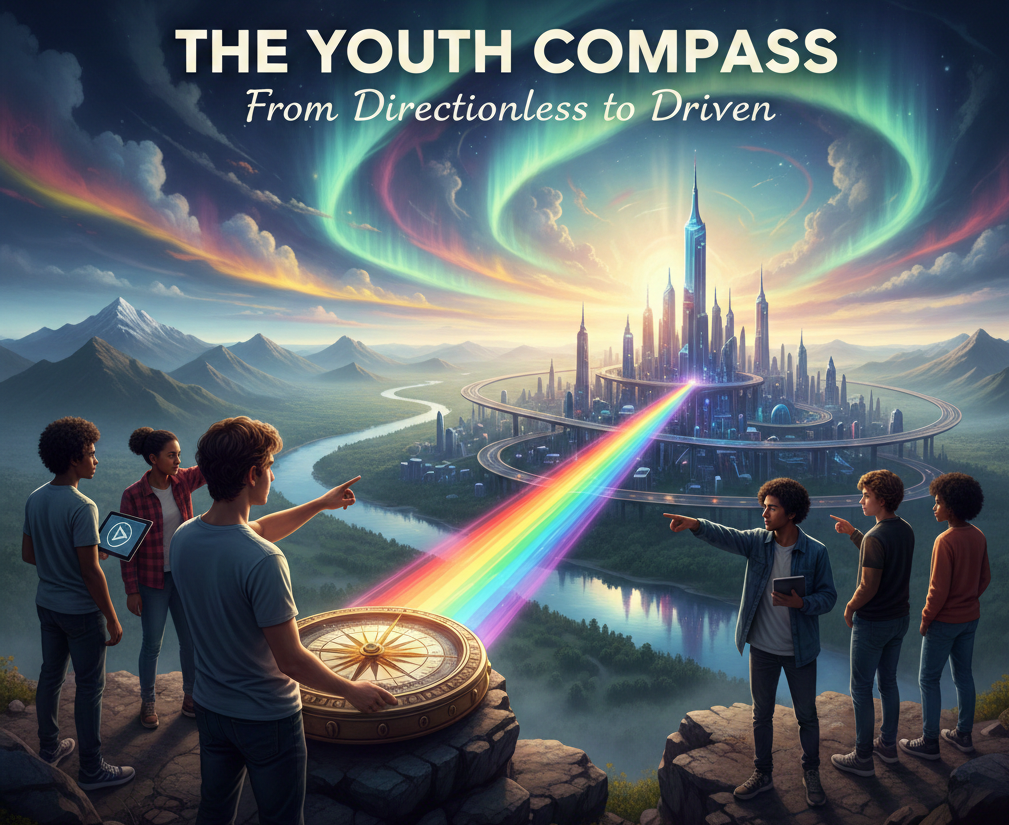
Part 4: The Youth Compass — From
Directionless to Driven
“Don’t rush to find your path. Build the compass that helps you walk it.” —
KV Shan
We often called this generation lost. But they’re not truly lost — they’re searching.
Searching for direction in a world that praises speed more than sense, performance more
than purpose.
The truth is, no one is born with clarity.
What separates the drifting from the driven isn’t luck — it’s awareness.
Awareness of one’s goals, strengths, and passions — the three coordinates that form what I
call The Youth Compass.
1. The Lost Generation of Potential
Walk into any classroom, and you’ll see a paradox.
Students overflowing with potential — yet quietly anxious, comparing, uncertain, and afraid
of not being “enough.”
Ask them their dreams, and you’ll hear silence, confusion, or borrowed ambitions.
They’ve been taught to run, not to reflect.
To achieve, not to align.
In a world obsessed with achievement, self-discovery has become the forgotten subject.
We push young minds to chase success — before they even know who they are.
That’s how a generation ends up directionless — not because they lack intelligence, but
because they were never handed a compass.
2. Why Direction is More Important Than Speed
The tragedy isn’t moving slowly.
The tragedy is moving fast in the wrong direction.
Modern culture glorifies motion — busyness, hustle, multitasking.
But without direction, speed just magnifies confusion.
The one who knows why he walks will always outlast the one who only knows how to run.
Life isn’t about being the fastest — it’s about being aligned.
And alignment comes from knowing your North Star (goals), your map (strengths), and
your fire (passion).
3. The 3-Layer Compass Model
Imagine a compass designed not for geography — but for life.
Its three essential parts are:
1. The North Star — Your Goals
Your North Star gives you direction. It doesn’t have to be perfectly defined; it just needs to
guide your movement.
Goals give life structure, meaning, and motivation. They keep you from drifting in circles.
Start small: set goals for growth, not just outcomes.
“Learn one new skill,” “Read 10 books this year,” “Help someone every week.”
These small stars eventually align into constellations.
2. The Inner Map — Your Strengths
Your strengths show you how to travel.
They are the tools and terrains where you move best.
When you know your natural abilities, you stop imitating others’ paths.
Strengths turn effort into flow — because when you work with your nature, even hard work
feels fulfilling.
3. The Fire Within — Your Passion
Passion is what fuels the journey when motivation fades.
It’s that emotional current that keeps you anchored even when results are delayed.
But passion is not something you “find” once — it’s something you feed daily, through
curiosity and practice.
Together, these three form your compass:
- Goal tells you where to go.
- Strengths show you how to go.
- Passion reminds you why you go.
4. How to Use the Compass Daily
Knowing your compass is one thing. Using it is another.
Here’s a simple 5-step practice young minds can use weekly to stay on track:
🧭 1. Reflect
Take 10 minutes every Sunday: “What gave me joy this week? What drained me?”
Reflection reveals alignment or its absence.
🎯 2. Adjust
If something feels consistently off, tweak your goals. You’re allowed to evolve.
Clarity grows through correction, not perfection.
🔥 3. Reconnect
Spend time doing something that ignites curiosity — not for reward, but for renewal.
Passion is like fire; it burns only when fed.
💪 4. Apply Strength
Find one task or project each week that uses your core strength — communication, analysis,
empathy, creativity, organization, etc.
The more you operate in your strength zone, the stronger your confidence becomes.
🤝 5. Seek Guidance
Reach out to mentors, peers, teachers, or even online communities that share your interests.
No compass works well without calibration — and mentors calibrate your direction.
5. The Role of Mentors, Parents, and Educators
If young people are the travelers, adults must become guides, not drivers.
Mentorship isn’t about giving directions — it’s about teaching navigation.
Parents and teachers must ask questions that awaken, not impose:
- “What made you happiest this week?”
- “What’s something new you’d love to try?”
- “What feels effortless for you?”
Instead of forcing answers, they must cultivate environments where exploration is celebrated.
A generation that’s allowed to explore early rarely gets lost later.
Learn how your heart and brain communicate with others without your permission
https://kvshan.com/2026/01/heartbrain-coherence-how.html
6. When Life Feels Unclear — Trust the Compass
There will be phases of fog — times when even the brightest minds feel lost.
That’s normal. Every explorer hits storms.
When it happens:
- Look at your goal — remind yourself why you began.
- Look at your strength — use what you’re naturally good at to rebuild momentum.
- Look at your passion — reconnect with what makes you feel alive.
Your compass may wobble, but it never disappears.
The key is to trust it even when the path isn’t visible.
Clarity doesn’t come before walking — it comes through walking.
7. A Message to the Dream-Builders of Tomorrow
To every young soul wondering, “What should I do with my life?” —know this:
You’re not late. You’re learning your direction.
Stop rushing to have it all figured out.
Start building the compass that will help you figure it along the way.
Your worth isn’t in your job title or your scorecard.
It’s in your curiosity, your courage, and your consistency.
Don’t chase trends; chase truths.
Don’t copy paths; carve yours.
Don’t seek certainty; seek understanding.
Because the world doesn’t need another person who’s successful by accident —
it needs individuals who are driven by design.
8. and Finally….
“When you know your goal, trust your strength, and fuel your passion —
the fog clears, and purpose appears.”
Every generation is shaped by its struggles.
Let this one be remembered not as The Lost Generation,
but as The Compass Generation — the youth who chose reflection over rush, alignment
over applause, and purpose over pressure.
End of Series: The Lost Compass — Helping Young Minds Find Their Direction
The Lost Compass : The Trilogy
1. Part 1 — When Goals Don’t Exist: Why young people drift without direction and how
to begin discovering purpose
https://kvshan.com/2025/10/series-title-lost-compass-helping-young.html
2. Part 2 — Discovering Strengths: How to identify innate abilities and align them with
meaningful goals.
https://kvshan.com/2025/11/rt-2-discovering-your-strengths-hidden.html
3. Part 3 — From Spark to Fire: How to evolve curiosity into lasting passion and purpose.
https://kvshan.com/2026/01/from-spark-to-fire-finding-and.html